Foreign couples can get married in Spain in a civil or a religious ceremony that has legal effect, or hold a symbolic ceremony that has none. For a civil marriage, the Spanish procedure starts at the registry office or notary of the town where at least one of you is registered and lives. That is one reason why many international couples marry legally at home and celebrate in Spain with a symbolic ceremony. This guide summarises what official Spanish sources and embassies say. It is general information, not legal advice. Rules and local practice change, so confirm everything with the civil registry or your embassy before you plan.
In this guide
- Getting married in Spain: three kinds of ceremony
- Civil marriage: who can celebrate it and the residence rule
- Documents and timelines, in general terms
- Religious ceremonies in Spain
- Symbolic ceremonies and what a celebrant does
- Why many international couples marry at home and celebrate in Spain
- Where the sources differ
- Rules change: confirm before you plan
Getting married in Spain: three kinds of ceremony
A wedding ceremony in Spain can be civil, religious or symbolic. Only the first two can create a legal marriage. The Spanish Civil Code (articles 49 to 60) recognises the civil form regulated by the Code and the religious forms provided by law. In our reading of these articles, a ceremony outside those forms has no legal effect.
| Ceremony | Legal effect in Spain | Who leads it |
|---|---|---|
| Civil | Yes. Effects start at the ceremony, and registration gives full recognition | The mayor or a councillor, a court official (letrado de la Administración de Justicia) or a notary |
| Religious | Yes, if it follows a form the law recognises, with the same registration | A minister of the religion |
| Symbolic | No | A celebrant, friend or relative of your choice |
Civil marriage: who can celebrate it and the residence rule
The Catalan courts’ portal (Seu judicial electrònica de Catalunya) describes a civil marriage in three parts: a file that shows you are free to marry, the ceremony, and registration at the Civil Registry. The file is handled by the registry office or by a notary. The ceremony is celebrated by a mayor or a councillor delegated by the mayor, a letrado de la Administración de Justicia (a court official) or a notary (Ley 20/2011, article 58).
The residence rule. This is the point that decides the route for most foreign couples. Article 51 of the Civil Code gives the competence for the file to the official of the place where one of the spouses is domiciled. The Catalan portal puts it plainly: the file can only be started at the registry office or notary of the municipality where one of you is registered on the town hall’s list (empadronado) and actually lives. The British government says that you or your partner must live in Spain or be a Spanish national. The US Embassy says applications go to the registry where at least one of the applicants lives. Read together, and as we understand them, these sources mean that a couple where neither person lives in Spain, and neither is Spanish, cannot start the civil procedure here. None of the official pages we read states a minimum length of residence, so ask the registry how it applies the rule to you.
Where the ceremony takes place. Once the marriage is authorised, the Catalan portal says you can celebrate it at any registry office, town hall or notary. A 2013 instruction of the registry authority removed the rule that a mayor’s wedding must take place in a room the town hall had set aside for it, but the town hall must still make sure the place is suitable. In practice, a civil wedding in another venue is a matter for the town hall. Barcelona’s page for weddings at the Saló de Cent shows how local the rules are: ceremonies in Catalan or Spanish, mostly on Friday afternoons and Saturday mornings, none in August, and no photography or video service of its own.
Documents and timelines, in general terms
Documents vary by registry and by nationality, so treat this as a map, not a checklist. The Catalan portal asks both of you to attend with two adult witnesses, and lists a signed application and a sworn statement of marital status; the passport, NIE or DNI of each of you and of the witnesses; and a recent certificate of registration (empadronamiento) and a recent full birth certificate for each of you. Foreign spouses also bring a civil-status certificate from their consulate, embassy or competent authority at home. Citizens of some countries, such as Germany, Austria, Italy or Switzerland, must also provide a certificate of marital capacity. If you were married before, you need divorce or death documents. Foreign documents need a sworn translation and an apostille or legalisation, with exceptions, and EU citizens can use multilingual forms instead (Regulation (EU) 2016/1191). You need all the documents before you can book the appointment, and the day the file opens is not the wedding day.
Your own country adds its own steps:
- United Kingdom. GOV.UK says the documents depend on the registry. You apply online for a marital status certificate, a certificate of no impediment or both, and the forms must be notarised in Spain.
- United States. The US Embassy says it cannot provide a document proving you are free to marry, because the United States has no equivalent, and it offers a statement to show the registry. US birth certificates need a Hague apostille.
- Ireland. The Embassy of Ireland issues a Certificate of Freedom to Marry. The declarations must be witnessed, for example by a Spanish notary, and be no more than six months old on the wedding date.
- France. The French embassy issues a certificate of capacity to marry (certificat de capacité à mariage). The banns are displayed for 10 days, the certificate must be translated by a sworn translator and it is valid for one year from the end of the banns. After the wedding, French citizens can ask for the marriage to be transcribed in French records.
| Source | What it says about timing |
|---|---|
| US Embassy | Approval of a marriage application in Spain can take up to 45 days. |
| French embassy | Request the certificate of capacity 3 months before the first interview with the local authorities. |
| Embassy of Ireland | Apply at least 4 months before the wedding. |
| Catalan courts’ portal | A civil marriage must be celebrated within one year of the authorisation. When the file ends in a certificate of capacity, for example for some religious ceremonies, the ceremony must take place within six months of the certificate. |
These lead times differ because they describe different steps: the certificate from your country, the Spanish file and the ceremony. Because the steps follow one another, start early. The longest advance notice any of these sources asks for is four months.
Religious ceremonies in Spain
The Civil Code gives civil effects to marriages celebrated under canon law and in other religious forms provided for in the agreements between the State and religious communities (articles 59 and 60). The Catalan portal lists agreements with the Federation of Evangelical Religious Entities, the Federation of Jewish Communities and the Islamic Commission. It also lists communities recognised as well established in Spain (notorio arraigo), such as the Church of Jesus Christ of Latter-day Saints, the Jehovah’s Witnesses, the Orthodox Church, the Bahá’í community and the Buddhist community.
For these non-Catholic forms, the portal says a marriage file and a certificate of capacity come before the ceremony. The consent is given before a minister of the religion and two adult witnesses, within six months of the certificate (Ley 20/2011, article 58 bis). Afterwards the marriage is registered at the Civil Registry on the minister’s certificate (Civil Code, article 63). Every religious body also sets its own requirements, so speak to it first.
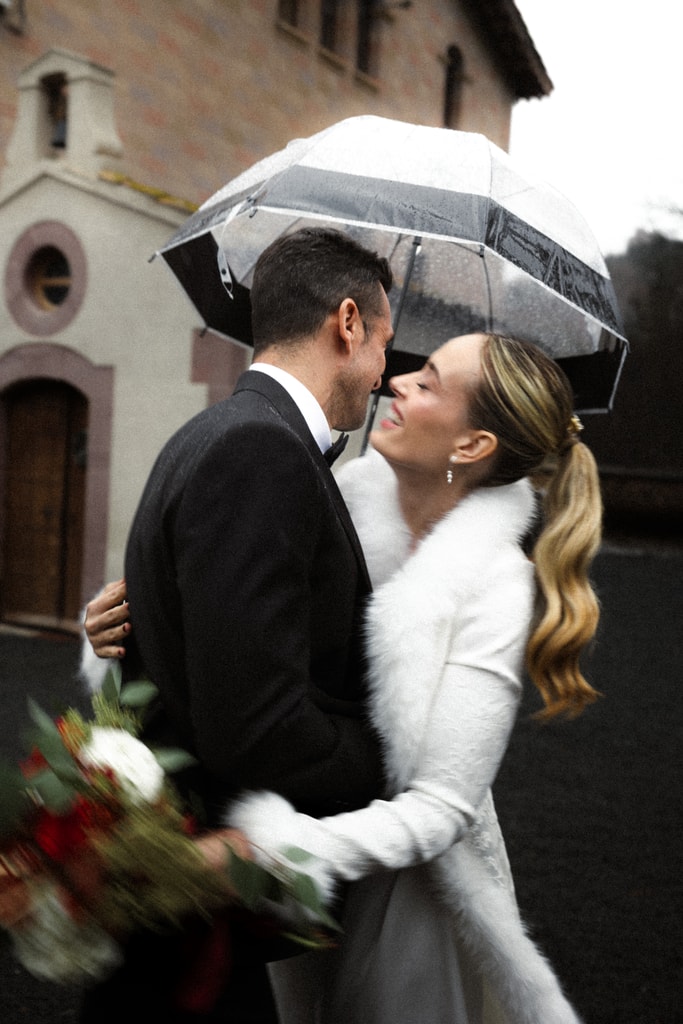
Symbolic ceremonies and what a celebrant does
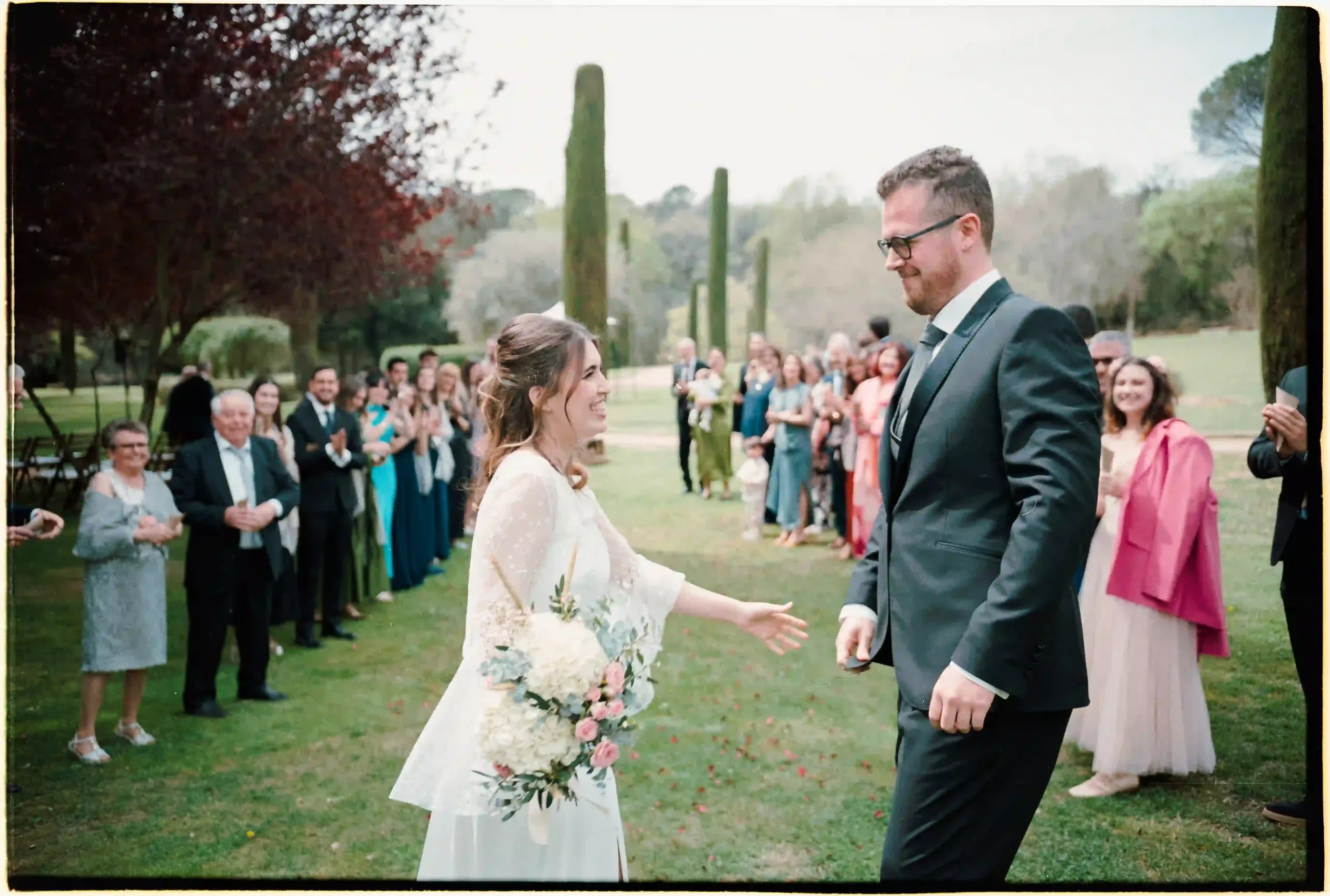
A symbolic ceremony is a celebration. It has no legal effect in Spain and needs no marriage file in Spain. You can hold it at any venue that agrees, in the languages you choose, led by whoever you choose. Couples use it to share the day with family and friends in a ceremony written for them: readings, personal vows, a ring exchange, music, a moment for parents or children.
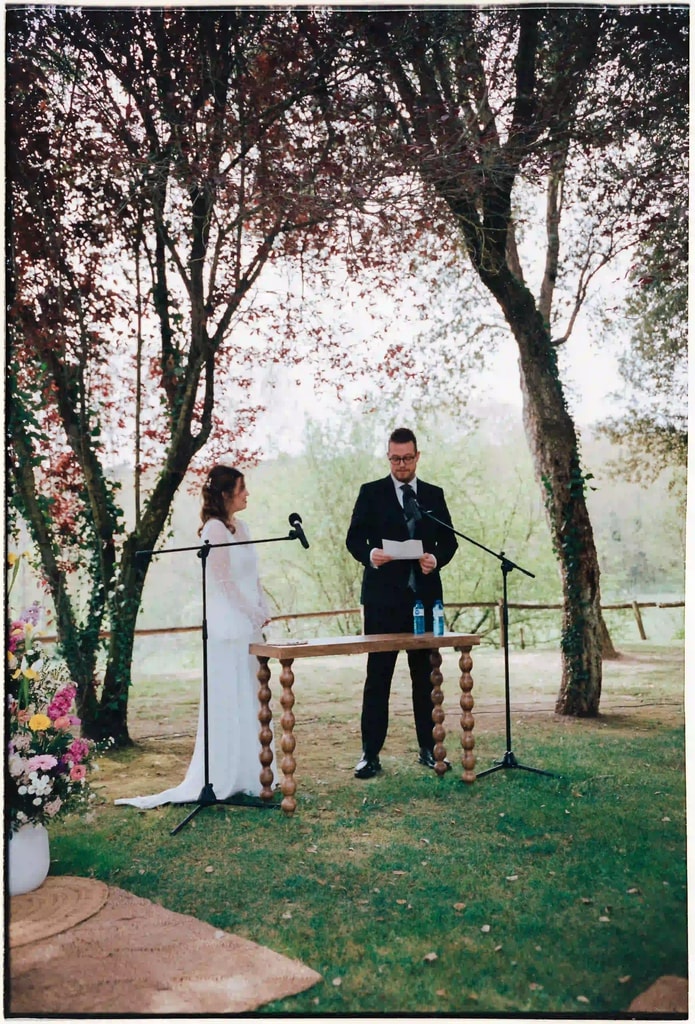
A celebrant plans and leads that ceremony. Typically they talk to you beforehand, write the script with you and run the order of the ceremony. Under Spanish law the people who celebrate a civil marriage in Spain are the mayor or councillor, the court official or the notary (Civil Code, article 51; Ley 20/2011, article 58). So a celebrant who is not one of them leads a symbolic ceremony, not a legal marriage.
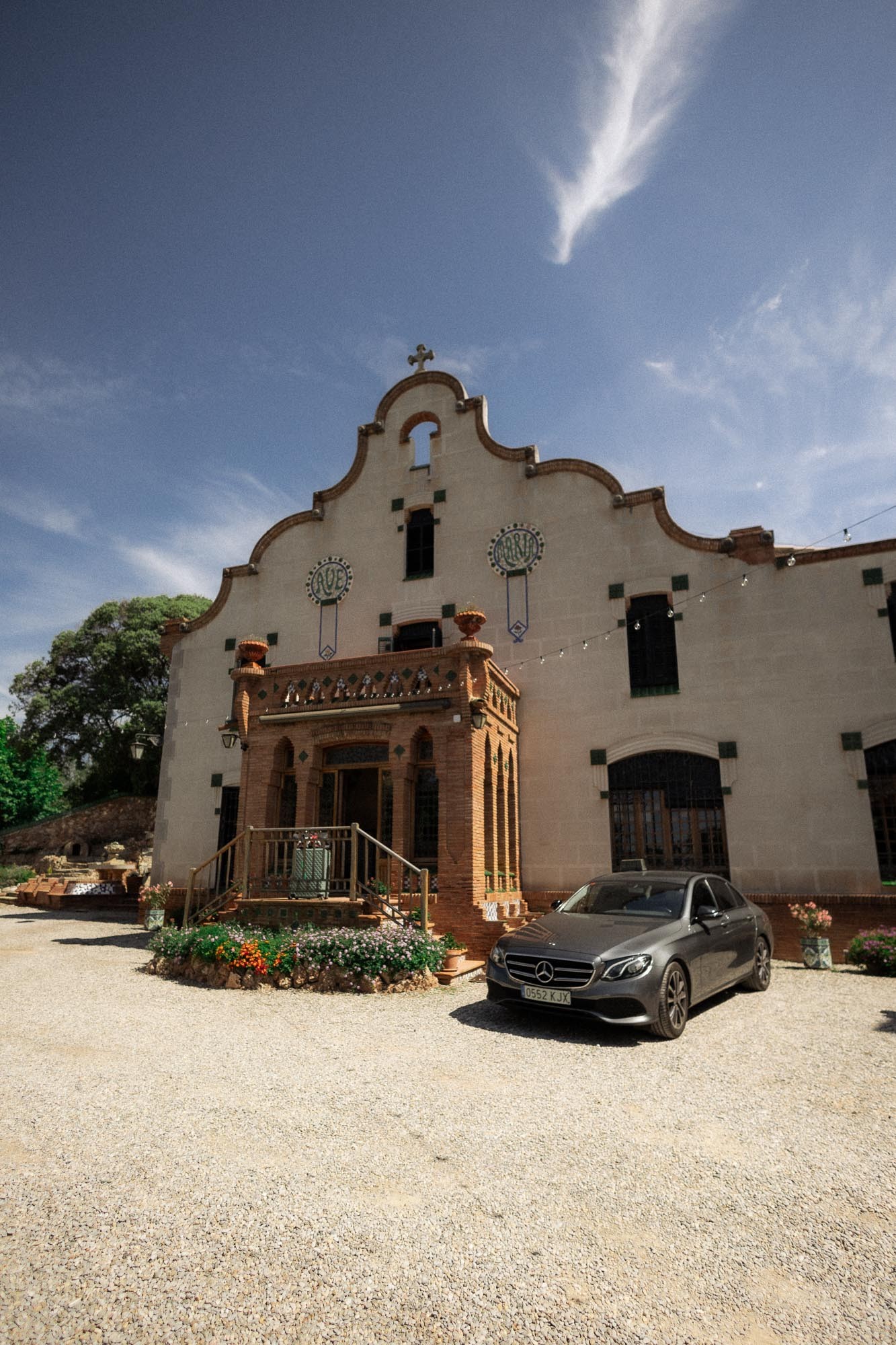
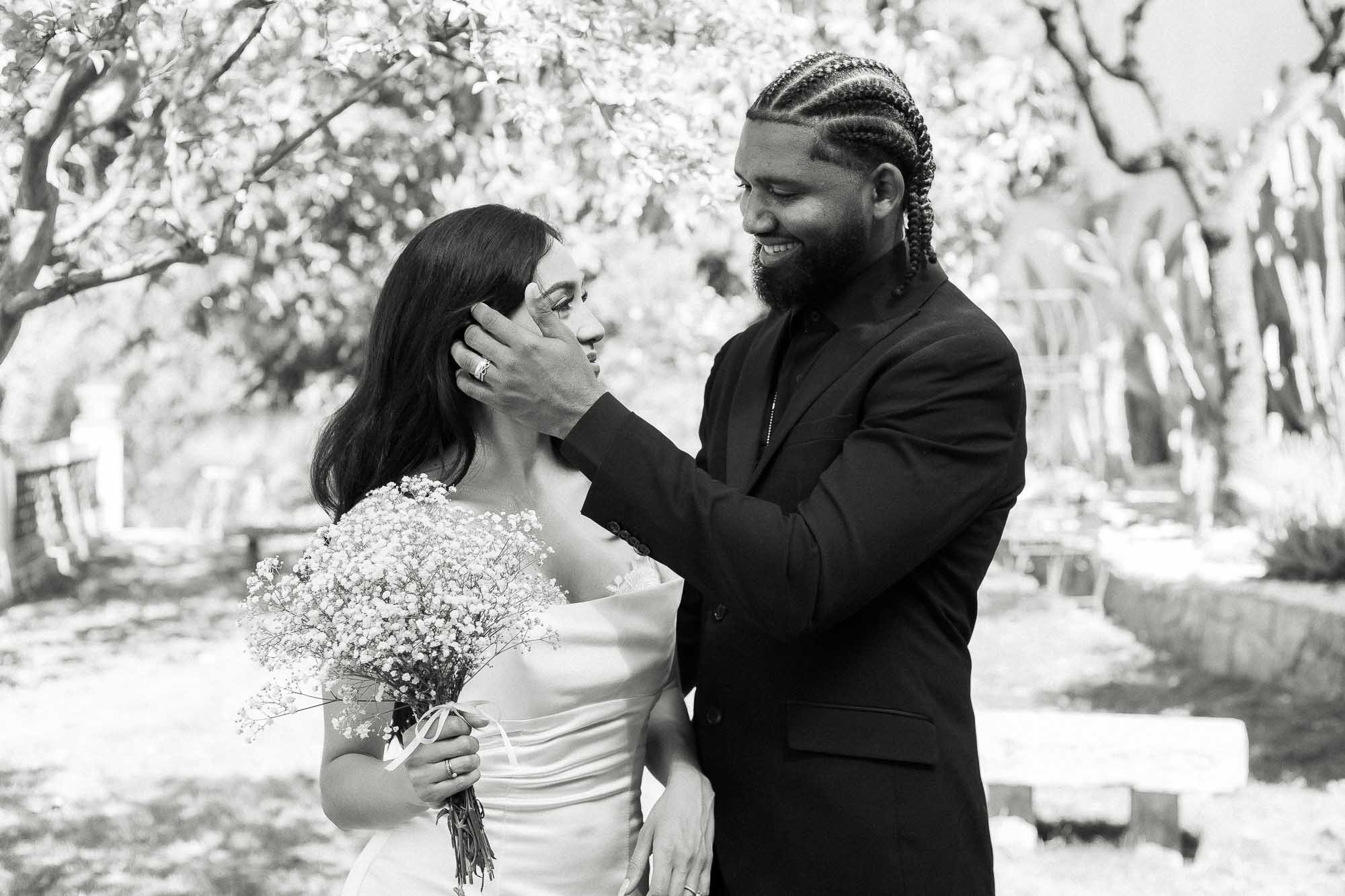
On the story of Mercedes and Jay, an American couple who married at Can Borrell in May 2024, the ceremony is credited to their celebrant, Jaume’s Weddings. You can read their story on our blog. The photographs show how a ceremony led by a celebrant looks, but they cannot tell you whether it was legal or symbolic. That depends on the paperwork and on who celebrated it.
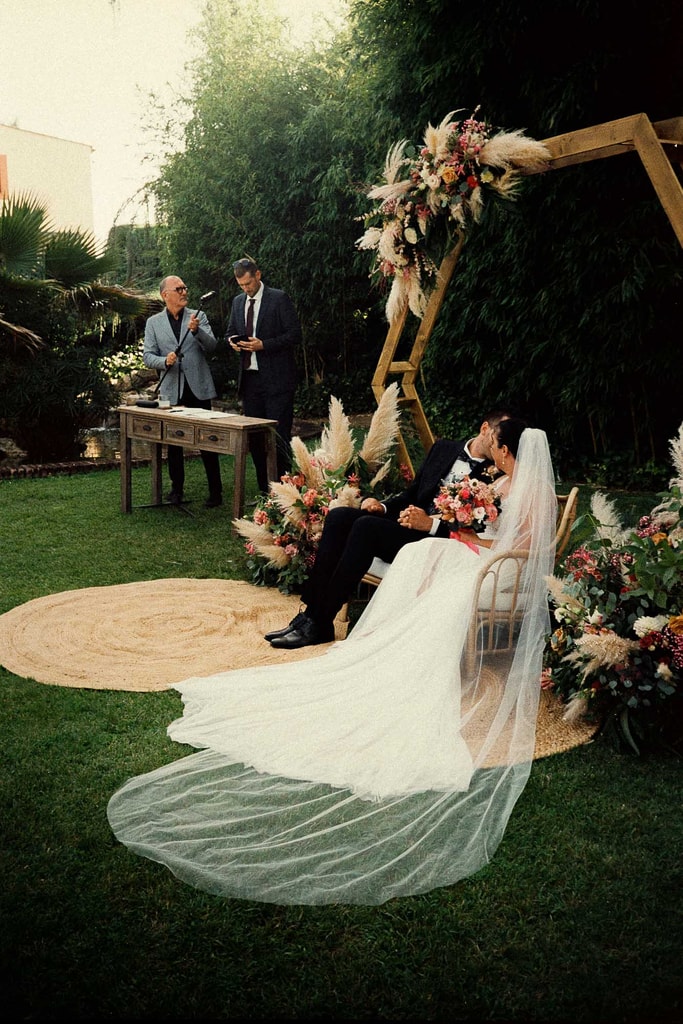
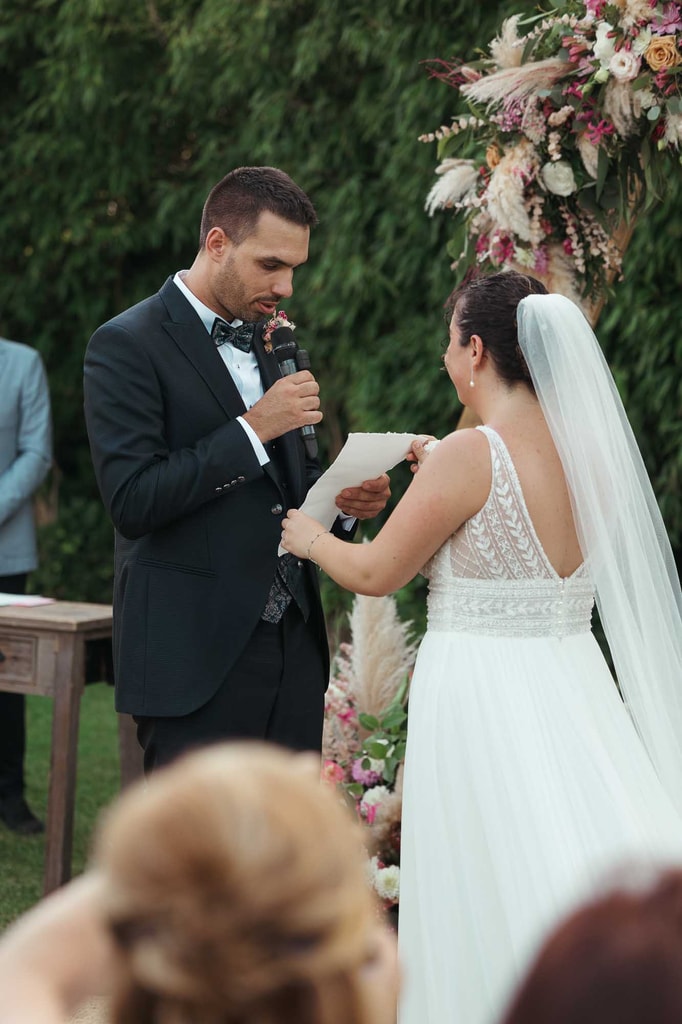
Why many international couples marry at home and celebrate in Spain
The usual reasons are practical. A civil file in Spain starts where one of you lives. It needs documents with an apostille and a sworn translation and, depending on your nationality, a certificate from your embassy with its own lead time. A legal marriage at home follows your own country’s rules, in your own language. A symbolic ceremony in Spain needs no Spanish file at all, so you can plan the day around the place, the guests and the season rather than the registry calendar.
If you do marry legally in Spain, check how your country treats the marriage afterwards. The US Embassy says a foreign marriage that is valid where it was performed is automatically valid in the US, and that a Spanish marriage certificate with a Hague apostille is enough to prove it. Surrey County Council says that in the UK a marriage that is valid where it took place should, as a general rule, be recognised. The French embassy says French authorities check before and after the marriage that both spouses are present at the ceremony. Ask your own embassy or registrar what your country needs.
Where the sources differ
Official pages do not always say the same thing. These are the differences we found.
- The residence rule. The Catalan portal says the file starts where one of you is registered and actually lives. The British government says you or your partner must live in Spain or be a Spanish national. The US Embassy says where at least one applicant lives. They agree on the idea, not on the wording, and none gives a minimum time. Article 50 of the Civil Code adds that if both spouses are foreigners, the marriage may be celebrated in Spain in the form prescribed for Spaniards or in the form set by the personal law of either of them. We found no official page that explains how this applies in practice today, so ask the registry or your embassy.
- Lead times. 45 days (US), three months (France) and four months (Ireland) describe different steps, so they do not contradict each other, but no source gives one total.
- Documents. The Catalan portal lists what registries in Catalonia ask for. The British government says the documents depend on where you marry, so a registry in another region can ask for something different.
Rules change: confirm before you plan
This guide summarises official sources read in October 2026. It is not legal advice and it does not replace the civil registry, a notary or your embassy. Laws and local practice change. For example, since 3 April 2025 the Civil Code no longer lists the juez de paz among those who can celebrate a marriage (Ley Orgánica 1/2025). The German Foreign Office says the same about marriages abroad in general: binding information on the formalities can only come from the local authorities. Before you fix a date:
- Decide which kind of ceremony you want in Spain: civil, religious or symbolic.
- For a civil or religious marriage, contact the registry office or notary of the town where one of you lives, and your embassy. Ask which documents they require and how long each step takes.
- Check what your own country needs in order to recognise the marriage.
- If you add a symbolic ceremony, plan it as a separate event with its own celebrant and timetable.
We photograph weddings in Barcelona, on the Costa Brava and across Catalonia, whichever kind of ceremony you choose. Tell us about your plans on our contact page, see our portfolio, or read our guide to the best time to get married in Barcelona and the Costa Brava.
Planning your wedding?
We would love to hear about your plans. Tell us about your day and let’s talk about how we can photograph it.